
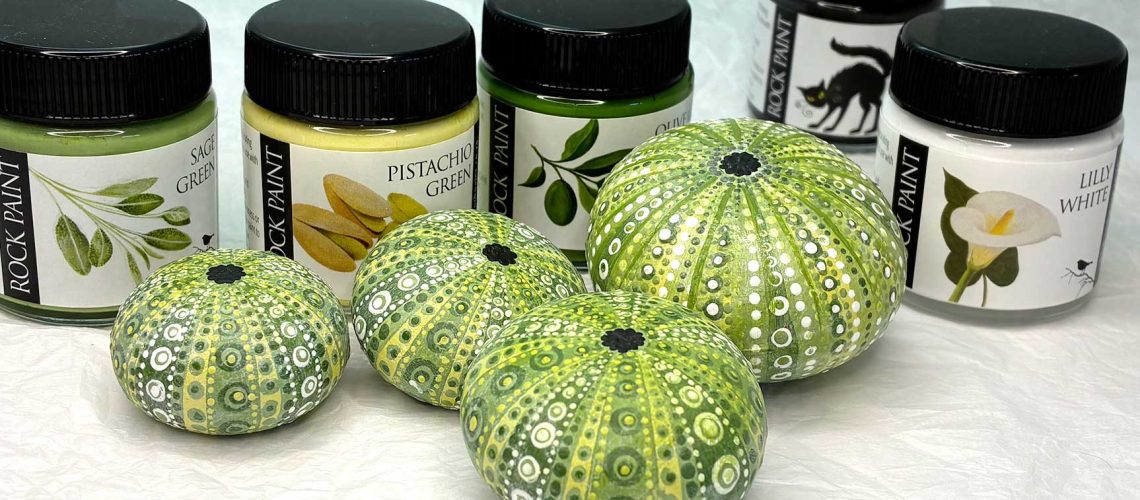

Bring a touch of coastal magic to your art table
Sea urchins are like tiny relics of the shore, their patterned shells delicate and full of quiet beauty. Painting them onto smooth, rounded stones turns a simple pebble into a treasure — glowing with layers of green and a sense of tide-pool wonder. With just a few shades of green paint, a fine brush, dotting tools and a sprinkle of patience, you can create a piece that looks intricate yet is wonderfully calming to paint.
These painted urchins are lovely as display pieces, tucked into a garden nook, or gifted to friends — small tokens of coastal magic to brighten any space.
Join me in creating one of your own Magical Sea Urchin Shells.
What you’ll need for this project:
Before you begin, gather your materials so everything is ready at hand. For sea urchins, rounded pebbles work best, especially if they’re slightly dome-shaped — they give a natural urchin feel once painted.
- Smooth, round pebbles (the more dome-shaped, the better)
- Rock Paint colours:
Pistachio Green
Sage Green
Olive Green
Jet Black
Lily White - Broad flat brush such as an F4 or F8
- Fine round paintbrush (R1)
- Dotting tools in various sizes
- Paint Mixing Dish: Shallow
- Circle Stencil
- Download the Sea Urchin worksheet PDF
- Toothpicks, a container for water, paper towel or a clean rag for drying and wiping off paint on brushes and dotting tools.
Let’s begin. Follow the step-by-step rock painting instructions and pictures below.
Step 1 – Choose your stones
If you’re very lucky, you might find naturally round, slightly domed pebbles — they’re perfect for this project. If not, don’t worry. You can also use cast stones made from molds of real pebbles, which give a similar smooth, rounded shape.
Step 2 – Paint the base coat
Using Pistachio Green, begin painting your pebble. Hold it gently between your forefinger and thumb and first paint the sides all the way around. Once that’s dry to the touch, paint the top surface. Leave the bottom bare at first so the stone can rest flat while drying. After a few minutes, flip it over and paint the underside too.
Step 3 – Add a second coat
Once the first layer is dry, give your pebble a second coat of Pistachio Green. Paint the sides and top first, let it dry, then flip it over and cover the underside. This ensures an even, glowing base colour.
Step 4 – Prepare your guide
Have your printed worksheet ready — it will help you keep the sections of your sea urchin evenly spaced.
Step 5 – Mark the centre
Using a regular HB pencil, make a small dot in the very centre at the top of your pebble. Do this by eye: rest the pebble on your surface, check the positioning carefully, and if it looks slightly off, simply erase and try again.
Step 6 – Print your worksheet
Sea urchins are made up of five main panels, so the worksheet uses a five-sided guide to help you mark these evenly. Print out a copy and keep it nearby.
Step 7 – Cut out a wedge
Using a pair of scissors, carefully cut along one of the wedge shapes on the worksheet. This will become your template for marking the panels.
Step 8 – Trace the first panel lines
Place the inside angle of the wedge over the pencil dot you made at the top of your pebble. Press the paper flat against the curve of the stone, then trace along one side of the cut-out, and then the other. This gives you your first panel guide.
Step 9 – Rotate the template
After tracing the first wedge, rotate your template around the centre dot. Line it up carefully and trace the next set of panel lines in the same way.
Step 10 – Continue marking the panels
Keep rotating and tracing until you’ve gone all the way around the pebble. Take your time pressing the paper flat so the lines stay even.
Step 11 – Check your layout
When you’ve finished, you should see five neat panels radiating from the centre dot. This will guide your painting and give your sea urchin its natural segmented look.
Step 12 – Add thinner wedges
With your pencil, draw an extra line about a third of the way to the left of each main panel line. This creates alternating thin and thick wedges, just like on a real sea urchin.
Step 13 – Extend the lines
Continue each line over the rounded sides of the pebble, carrying them neatly all the way to the base. This way, the pattern will wrap around the whole stone.
Step 14 – Mix your greens
Now it’s time to bring colour back in. Place a blob each of Olive Green and Sage Green into your mixing dish. A white porcelain dish or saucer works beautifully, or you can recycle the white plastic lid of a yoghurt tub — simply dispose of it when you’re done. For the next step, you’ll be mixing the two greens together, so place the blobs close together on your palette.
Step 15 – Mix your mid-green
On your palette, blend the Olive Green and Sage Green together until you have a smooth, even mid-green. You can use your R1 brush to do this.
Step 16 – Prepare your brush
Lightly wipe your brush on a paper towel to remove excess paint. This helps you keep a clean edge when you start painting.
Step 17 – Start painting the wedges
Using your R1 brush, begin filling in the narrow wedges. Use the fine tip to reach the pointed ends, then glide the brush along the line to cover the rest of the wedge.
Step 18 – Work around the stone
Continue painting all of the narrow wedges in the same way until the whole pebble is patterned with alternating light and dark green sections.
Tip: Don’t worry if the coverage looks a little streaky at first — once the paint is dry, a second coat will even everything out.
Step 19 – Finish the narrow wedges
Paint each of the narrow wedges all the way down the sides of the pebble and onto the bottom so the pattern wraps neatly around. When loading your brush, dip it only halfway up the bristles (not all the way to the metal ferrule). This keeps the brush easier to control and prevents paint from clogging near the top. Allow the paint to dry completely.
Step 20 – Add a second coat (if needed)
If the first coat looks streaky or uneven, apply a second layer of mid-green. Don’t worry about getting it perfectly smooth — the surface will soon be covered in hundreds of tiny dots.
Step 21 – Mark new guidelines
Once the paint is dry, use your HB pencil to draw additional lines around the pebble. These lines should sit just beside the painted green wedges, creating a set of slimmer pencil-marked wedges alongside them.
Step 22 – Define the wider wedges
The spaces left in between — the unpainted pencil-marked sections — will now form your wider wedges. These alternating wide and narrow panels will give your sea urchin its natural, rhythmic pattern.
It may look a bit messy at this stage, but the dotting will soon transform it into something intricate and beautiful
Step 23 – Prepare your Sage Green
Place a small blob of Sage Green onto your paint palette.
Step 24 – Load your brush lightly
Dip your brush into the paint only partway up the bristles, keeping the tip flexible and easy to control. This will help you paint neat, sharp edges as you move into the next wedges.
Step 25 – Paint the inner wedges
Fill in the larger inner wedges with Sage Green, leaving the very thinnest pencil-marked wedges unpainted. Work slowly and carefully, guiding the brush into the narrower tips of the wedges.
Step 26 – Clean and review
Once you’ve painted the inner wedges, rinse your brush thoroughly in water to remove all the green. Gently dry it on a paper towel, then re-shape the bristles with your fingers (or by rolling lightly on the towel). Keeping your brush clean between layers helps each colour go on smoothly. At this stage, your pebble should show a pattern of alternating wide and narrow sections all the way around.
Step 27 – Add pencil guides to the Sage Green wedges
Once the Sage Green paint is dry, take your HB pencil and draw two lines inside each Sage Green wedge. Place them closer to the outer edges so the wedge is divided into three parts: two narrow side sections and one thicker central section. These pencil guides will help you add more definition in the next stage.
Step 28 – Paint the Olive Green panels
Place a blob of Olive Green onto your palette. Load your brush carefully (dipping only halfway up the bristles), then begin painting the central section of each Sage Green wedge. Work neatly between the pencil lines you added in Step 27. Continue until all five Olive Green panels are complete. Allow the paint to dry fully before moving on.
Step 29 – Prepare to dot
Add a small blob of Lily White paint onto your palette. Dip just the rounded metal end of your largest dotting tool into the paint — not too deep, just enough to cover the tip. Place your first dot near the edge of an Olive Green panel. Without reloading, place a second dot just beside it, then a third, moving towards the centre. Each dot will naturally be smaller as the paint lessens on the tool, creating a perfect tapering line.
Step 31 – Continue to the centre
Switch to a smaller dotting tool as you move closer to the middle, keeping your line straight and even. The dots should get smaller and more delicate towards the centre.
Step 32 – Repeat for all panels
Work in the same way on each of the remaining Olive Green panels until all five have a neat, tapered line of white dots running from edge to centre.
Step 33 – Extend the white dots over the edge
Once the top rows of white dots are fully dry, carefully continue the dotted lines down the curved sides of the stone, all the way to the bottom. Handle the pebble carefully — dotted paint takes longer to dry than flat brush layers and can smudge if touched too soon.
Step 34 – Keep your tools clean
Clean your dotting tool thoroughly after use. If the paint starts thickening or drying on the tip, wipe it off on a paper towel — otherwise it can affect the neat, rounded shape of your dots.
Tip: To save time, work on two or three pebbles at once. While one is drying, you can move on to the next — it keeps the process flowing and prevents accidental smudges.
Step 35 – Add Olive Green dots
Next, place a blob of Olive Green onto your palette. Using the same method as with the white dots, start a new line of dots along each mid-green panel, beginning at the centre top and tapering the size smaller as you move towards the sides.
Step 36 – Complete the mid-green panel
Continue adding Olive Green dots along the remaining mid-green panels, using the same tapering technique as before. Work steadily across all the panels for an even look.
Step 37 – Dot the sides and bottom
Once the top surfaces are dry, carefully extend the Olive Green dots down the sides and onto the bottom of the pebble. Handle the stone gently to avoid smudging the still-drying dots — they take longer to set than brush-applied paint.
Step 38 – Keep your tool clean
Between sections, wipe the tip of your dotting tool on a paper towel to prevent paint build-up. Dried paint on the tip can affect the neat, round shape of your dots.
Step 39 – Add Sage Green dots
When the Olive Green dots are completely dry, place a small Sage Green dot in the centre of each one. Use a smaller dotting tool so the Olive Green still shows as a neat outline around the Sage Green. This layering effect gives the sea urchin its textured, dimensional look.
This is the moment when the urchin really starts to come to life!
Step 40 – Layer Sage dots inside the white
Once the Sage dots from Step 39 are completely dry, dip a smaller dotting tool into Sage Green. Carefully place a dot in the centre of each white dot, leaving a neat white outline showing around the edge.
Step 41 – Work across all panels
Continue this process across every panel until all the white dots have a Sage Green centre.
Step 42 – Add lines of Sage dots
Still using Sage Green, switch to a smaller dotting tool. Add a neat line of tiny dots down each Pistachio Green wedge — these are the unpainted narrow wedges left after painting all the others.
Step 43 – Review your pattern
At this stage, the pebble should be covered in alternating rings and dotted lines, creating the layered texture of a real sea urchin shell.
Step 44 – Extend the dots over the sides
Once the top rows are completely dry, carefully continue the Sage-and-White dot patterns down over the curved edges and onto the bottom of the pebble. Take your time — handling the stone too soon can smudge the dots.
Step 45 – Add Olive Green lines of dots to Sage wedges
Using the smallest dotting tool you have, dip into Olive Green and place a line of tiny dots down each Sage Green wedge. These should sit neatly between the Olive Green and Pistachio wedges, giving extra definition to the pattern.
Step 46 – Dot inside the Sage dots
Still with Olive Green, add small central dots inside the Sage Green dots that were placed over the Olive Green panels earlier. This creates a layered, “ringed” effect that mimics the texture of a real sea urchin shell.
If you’re working on more than one pebble at a time, rotate between them so you’re never dotting on damp paint
Step 47 – Watch your urchin come to life
By now, the layers of dots are giving your pebble the realistic texture of a sea urchin shell. Each new detail adds to the overall effect.
Step 48 – Add the tiniest dots with a toothpick
Place a blob of Lily White paint onto your palette. Dip the tip of a wooden toothpick lightly into the paint and begin dotting along the edges of each Olive Green wedge. Because a toothpick doesn’t hold much paint, you’ll need to reload it often and wipe it clean on a paper towel to keep the dots crisp. Work your way carefully around the pebble.
Step 49 – Dot inside the Sage rings
While you still have Lily White on your palette, switch back to your dotting tool (using the small end). Place a neat white dot in the centre of each Sage Green dot that sits on top of the earlier white dots. This creates a layered, three-tone effect that really enhances the urchin’s pattern.
At this point, your pebble already looks like a miniature sea urchin — next we’ll keep layering the detail for an even richer effect.
Step 50 – Tiny Pistachio borders
Dip a wooden toothpick into Pistachio Green and dot a fine line down either side of the panels that already have Olive–Sage–Olive dots. Work all the way around the pebble, keeping your dots as even as possible.
Step 51 – Pistachio highlights
Using the same Pistachio paint, place a small dot in the centre of each Olive–Sage–Olive dot. This soft green highlight ties the colours together beautifully. Continue all the way around the urchin.
Tip: A toothpick doesn’t hold much paint, so you’ll need to reload it frequently. Wipe it clean on paper towel every now-and-then to keep your dots neat and crisp.
Step 52 – Final Olive Green dots
Add the very last dots: use Olive Green on your dotting tool to place neat dots inside the Sage Green dots. This completes the layered pattern.
Step 53 – Let it dry fully
Set your pebble aside and allow all the dotting work to dry completely before moving on. This ensures the finishing layer won’t smudge.
Step 54 – Prepare your white wash
Place a small blob of Lily White paint on your palette. This will be used to create a thin film over the entire urchin to soften the colours and give a more natural look.
Step 55 – Dampen the pebble
Using a clean, damp cloth, gently wipe over the whole pebble so there’s a very light layer of water on the surface. This helps the thin white wash glide smoothly.
Step 56 – Apply a touch of white
Dip your fingertip into the Lily White paint. (If you prefer, you can use a wide flat brush instead — just be sure to keep the layer very thin.)
Step 57 – Begin spreading the paint
Wipe the paint directly onto the pebble, starting with a small section.
Step 58 – Rub in a thin layer
Quickly spread the paint across the entire pebble with your finger, creating the thinnest possible veil of white. Cover the top, sides, and bottom in one go so the layer stays even.
Step 59 – Wipe back with a damp cloth
Before the paint dries, use your damp cloth to gently wipe over the pebble. This softens the layer and lets the pattern shine through, giving the surface a natural, sea-washed look.
Note: The thin white wash is what makes your urchin look especially realistic, softening the colours into a natural shell effect. If you’re not confident, you can leave this step out — your pebble will still look beautiful. But do give it a try if you can! Just remember: keep the layer very light. If too much paint goes on, it will hide all your beautiful work work.
Step 60 – Mark the central circle
Find the centre top of your sea urchin. Place your circle stencil (or freehand if you prefer) and use an HB pencil to draw a circle about 7 mm in diameter.
Step 61 – Paint the circle
Fill in the circle neatly with Sage Green paint, keeping your brush strokes smooth. Allow it to dry completely before continuing.
Step 62 – Add a smaller circle
Once the Sage Green is dry, use the stencil again (or freehand) to draw a smaller circle inside it, making sure it stays concentric. This forms the beginning of the central urchin detail.
Step 63 – Paint the centre
With a fine brush, fill the smaller inner circle using Jet Black paint. Take your time to keep the edges clean and round. Let it dry fully.
Step 64 – Add the final ring of dots
Using a medium-sized dotting tool and Lily White paint, place a neat ring of dots around the edge of the black circle. This adds the finishing touch to your urchin’s central feature.
And you’re finished! You now have a hand-painted sea urchin pebble — a delicate, detailed piece that looks just like a real urchin shell. Perfect to display, gift, or keep as a calming reminder of the sea.
We’d love to see your creations!
Share your painted sea urchins with us on Instagram using the hashtag #rockpaint_capetown, or post them on our Facebook page: Rock Paint Cape Town.
Products used in this tutorial
-

Jet Black 50ml
R44.00 Add to cart -

Lily White 50ml
R44.00 Add to cart -

Olive Green
R44.00 Add to cart -

Pistachio Green
R44.00 Add to cart -

Starter brush set
R196.00 Add to cart -

Double-Sided Dotting Tool Set of 5
R70.00 Add to cart -

Sage Green
R44.00 Add to cart -

Circle stencil
R57.00 Add to cart -

Paint Mixing Dish: Shallow
R25.00 Add to cart


